
Garmin Health Research Glimpse: Exploring Stress Research
April 29, 2025
How Garmin smartwatches drive collaborative health innovation.
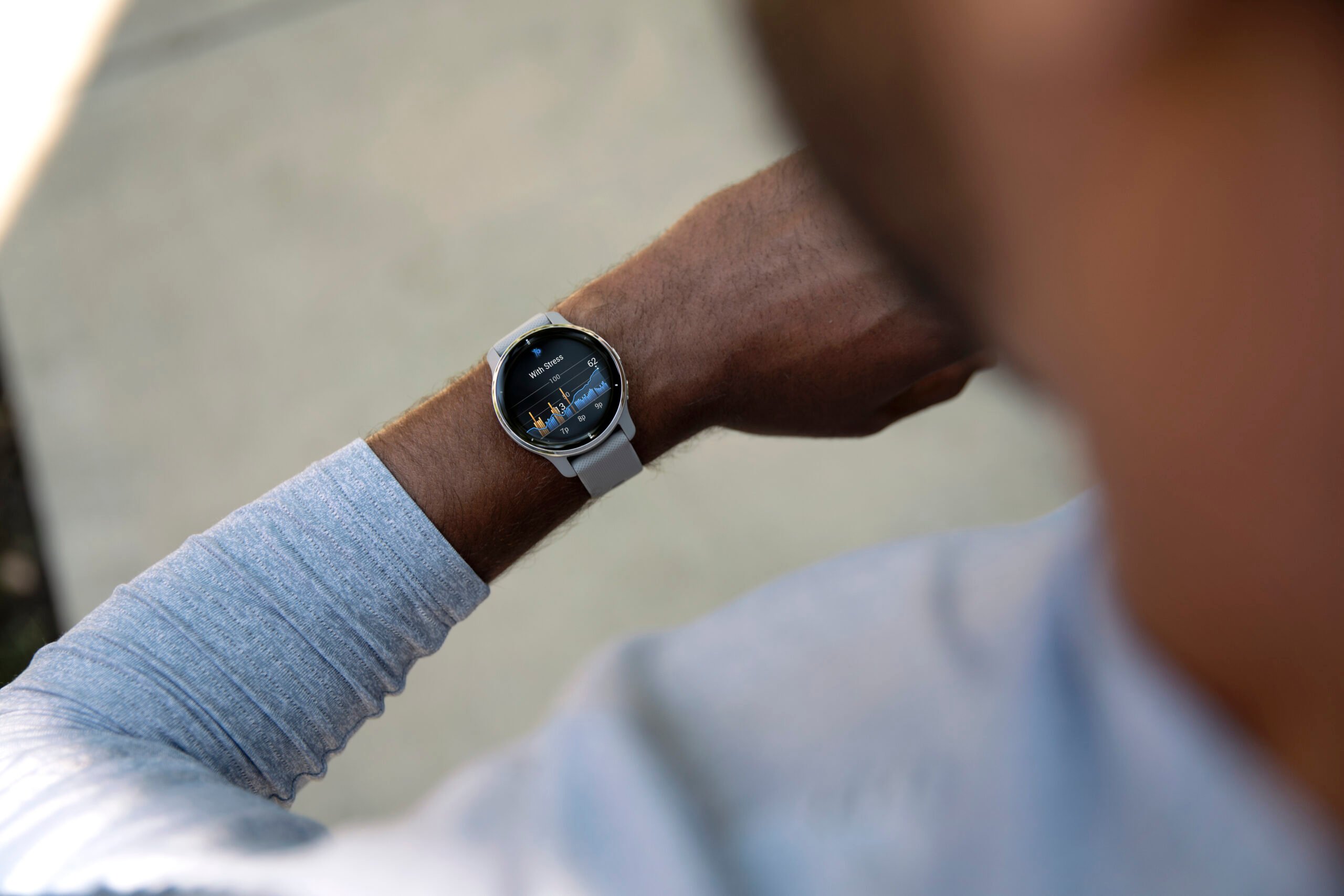
Understanding the impact of stress on the body is crucial for crafting effective health interventions. Below we present three research projects that demonstrate how all-day stress tracking with compatible Garmin smartwatches can offer insights into the body’s fight-or-flight response to stressors and support collaborative efforts in advancing health outcomes. Learn more about Garmin stress tracking technology.
Study analyzes biometrics of offshore wind industry workers
TUM Universityhospital, Telemedicinecenter, Munich, Germany

The study: Researchers collected Garmin smartwatch biometric data from wind industry workers to help support industry best practices for health and safety, help mitigate risks and increase efficiency.
How Garmin factors in: Fifty offshore workers wore Garmin Venu® smartwatches for 28 days. Health metrics such as heart rate variability (HRV), stress, and sleep patterns and quality1 were collected, and participants filled out a daily well-being questionnaire. Researchers in the telemedicine centre monitored participants’ vital signs 24/7 in real time using the Garmin Health SDK to gain valuable insights into how participants responded to their 14-day shifts.
The goal: The research team aims to prove this method as a powerful way to uncover how offshore workers react physically to challenging environments. In future phases, they’ll pinpoint and test predictive health markers, unlocking the potential for real-time alerts to tackle health risks tied to offshore life.
Study uses smartwatch heart rate data to predict emotional responses
National Central University, Taiwan (NCU)

The study: Researchers at NCU created the MindFit app to help improve mental health and well-being. The app uses an AI model to predict emotions based on HRV data collected by Garmin smartwatches and personal mood journal entries.
How Garmin factors in: Using the Garmin Health Companion SDK and Forerunner 255 smartwatches, raw beat-to-beat interval data was used to determine participants’ HRV. Individuals recorded their moods in the MindFit app developed at NCU, and a proprietary AI model predicted emotions based on the objective and subjective data. The study also integrated a language model to provide real-time supportive or encouraging messages to participants.
The goal: Researchers hope the mood tracking app will help reduce emotional fluctuations and enhance personal psychological well-being by helping users focusing on happiness, well-being and positivity instead of mental illness, maladaptive behavior and negative thinking.
Northeastern and Dartmouth study validates Garmin wearables as a reliable solution for clinical trial research
Dartmouth College’s Center for Technology and Behavioral Health, Ubiquitous Computing for Health and Well-being Lab (UbiWell) at Northeastern University, U.S.
The studies: Recent studies conducted by Dartmouth College and Northeastern University determined that Garmin smartwatches produced reliable health data in a variety of settings, including clinical populations.
“The study on stress detection found that the Garmin Forerunner® 55 provided valuable HRV insights and is a good alternative to ECG-based, research-grade devices using PPG,” said Varun Mishra, Assistant Professor of Computer Science and Health Sciences at Northeastern University in Boston, Massachusetts.
How Garmin factors in: Thirty-five research participants wore Forerunner 55 watches to help evaluate the reliability of capturing stress levels and build effective context-aware models to detect stress in real-world settings. Funded by the National Institute on Drug Abuse, the project aimed to understand ways to manage stress levels — including early detection — while assessing how well individuals can improve stress management, ultimately helping reduce the risk of anxiety, depression, smoking or drug use.
The goal: Project researchers hoped to prove the effectiveness and affordability of Garmin wearables and their health features in a clinical trial setting.
The result: Researchers found that the Forerunner 55 was easy to wear and use and could log raw sensor data with impressive battery life. Researchers also determined that the Garmin smartwatch was an affordable solution for meaningful research, when combined with the Garmin Health SDK, and should help attract other researchers to use reliable Garmin wearables in the clinical trial space.
Could Garmin smartwatch technology and the Garmin Health connected ecosystem play a vital role in your next health or clinical study? Contact us today to find out more.
To learn more about related projects, visit www.garmin.com/third-party-studies-overview for more research projects with Garmin Health. All information on research and…