
inReach SOS: Snowmobiler caught in an avalanche
March 18, 2026
While snowmobiling familiar terrain with three others, Joe Kruljac observed a large crack in the snow between two riders. Before anyone could react, one rider was swallowed up in a wall of snow. He shared what happened in the aftermath, and how he used his inReach® satellite communication device1 to get help that day.
One bright, beautiful snowmobiling day, a group of four of us were riding in an area of Wyoming we have all been before, traversing across challenging creek bottoms and exploring untouched powder up and over ridges.
With the record snowfall that season, we were cautious of avalanches and areas prone to slides. All of us had our avalanche backpacks, shovels, probes and beacons, and we had practiced and understood the protocol fully.
It was 2 p.m., and we were on a mountainside we have gone up and over many times. We stopped at the bottom to discuss our options. One person in our group decided to try a route and conveyed “Stay put and let me go look.”
We all know to go one snowmobile at a time on a steep slope, but as the initial rider started up, a second rider decided to follow. They were about five sled-lengths apart as the rest of us shouted in our intercoms for the second rider to stop.
Before anything could be done, we observed a large crack in the snow between the two riders, and an avalanche started between them. The first rider made it to the top and the second rider tried to get out of the way, but it was too late, and the rider got swallowed up in a wall of snow and knocked off the snowmobile. We all kept an eye on the rider who was in the avalanche — watching them tumble and disappear and finally seeing their avalanche air bag deploy.
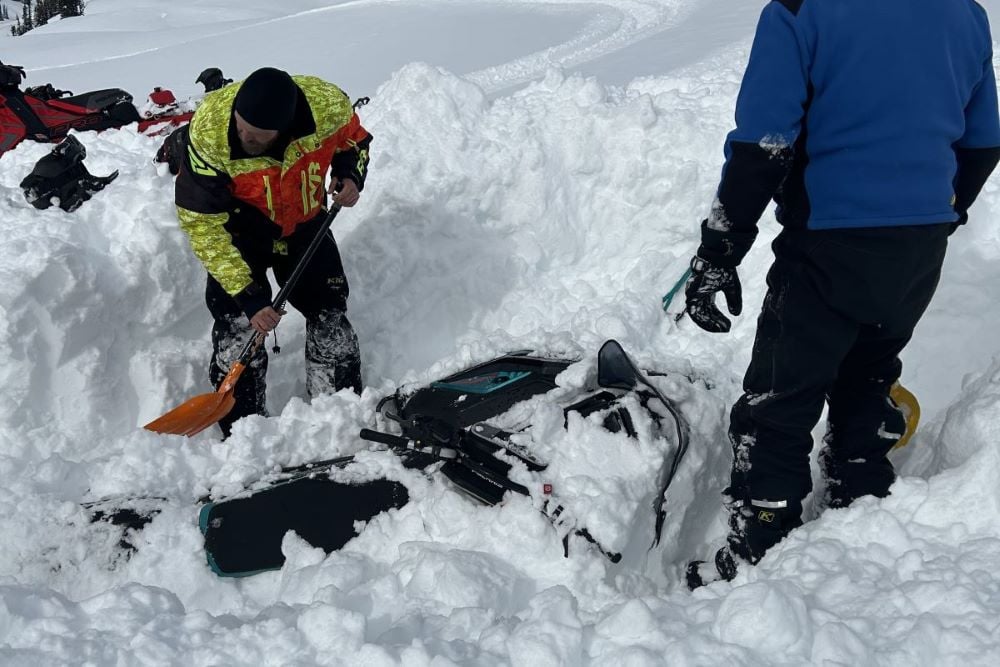
As the slide came to a stop, we rushed over to the rider who was buried up to their chin. Their snowmobile was nowhere to be seen.
We started our rescue digging procedures and eventually freed them. A member in our group is certified in first aid and examined their overall condition. They were in a lot of pain but there were no broken bones or bleeding. We kept the individual warm with a fire and bivy bags.
We decided that riding out was less of an option, so I triggered an SOS message on my Garmin inReach device. I had the inReach paired to my phone and started communicating with the Garmin Response℠ team member, who also put me in touch with the local search and rescue (SAR) team.
Pairing to my phone worked out well because there was a lot of texting back and forth with updates to and from Garmin Response and the SAR commander. I requested a helicopter as the SAR team conveyed they would have trouble getting to where we were with a snow buggy. Then the wait started.
We had dug the rider out at 3 p.m. and by 4:30 p.m., it was getting dark and cold as a storm moved in. Our hopes faded as the Garmin Response team conveyed that helicopters made two attempts from two different locations, but the weather was too bad for a flight.
The SAR commander updated me that they were still coming to our location, so I communicated that a rescue sled buggy would not make it to our location, and we would instead get the victim out and meet them. Securing the victim to another rider on the same snowmobile was tricky, and we had to work hard to avoid getting that snowmobile stuck.
By the time we were past a bad spot on the mountain, it was dark and the avalanche victim conveyed “Just keep going and get me out.”
The SAR team had our location updated continuously from the inReach device, and eventually they caught up to us. They assisted in making a packed trail to the warming hut where an emergency snow buggy and other members of the team had a fire going and were ready for our arrival.
After a medical assessment, the decision was made to carefully secure and transport the injured individual to the waiting snow buggy and then take the 15-mile ride down a groomed trail to the trailhead where an ambulance was waiting.
Severe bruising from the mid torso and down both legs was discovered at the emergency room, and they said that the decision to get the victim out as soon as possible was a good move.
In retrospect there were a few key things that led to this amazing outcome:
- Having the inReach device. Given medical attention was paramount, it would have been a much more dire situation without it.
- Pairing the inReach device to the phone made conversation between all dispatchers stress-free.
- Having the SAR team know our every move via inReach location sharing.
All members of our party now have an inReach device, and we’re so grateful for individuals who volunteer for SAR and work for ambulance services. We commend the helicopter pilot’s decision not to fly in weather that was not safe for everyone, and the Garmin Response team for keeping my family aware of the situation.
1Active subscription…