
How Garmin Tech Helped This Golf Pro Train for a Marathon
June 11, 2025
PGA TOUR pro and three-time champion Scott Stallings ran the Boston Marathon. Here’s what he had to say about his journey — and how he used Garmin to accomplish his goals.
PGA TOUR pro Scott Stallings never considered himself a runner. He was a golfer through and through.
This year the three-time PGA TOUR champion ran his first marathon. And not just any marathon: He ran Boston. And he ran it for charity.
After injuring his shoulder and elbow in 2024, he’d been taking time away from the tour to recover, but he needed a new challenge. So Scott began training to run the Boston Marathon to raise money for Golf Fights Cancer, a nonprofit founded by Jay Monahan, current PGA TOUR commissioner, and Brian Oates.
We talked to Scott, a Garmin-sponsored athlete, after he finished the Boston Marathon with a time of 4 hours and 10 minutes. Here’s what he had to say.
You just finished the Boston Marathon. What did it mean to you to be able to run that race?
SS: I didn’t realize it was kind of a lifelong dream or bucket list or any of the other 10,000 cliché things you hear … I knew it was a big event. I had in my mind what I thought a great day was going to look like. And Monday happened and it far surpassed anything — I definitely didn’t want it to be over.
What was your favorite part about that experience?
SS: Whether you’re an ultra-competitor that gets up in the in the front in that first 30 minutes of the race, or you’re in the back charity part like me, you see the best parts of the world all happening at once.
Why did you decide to run this race? Would you run a marathon again?
SS: I would 100% run a marathon again. I tore my shoulder at the Players Championship in 2024 — kind of a freak injury. I had my shoulder fixed in June, and I was still having some pretty bad residual problems in my elbow. A friend of mine had given me a book a while ago by Steve Magness called “Do Hard Things: Why We Get Resilience Wrong and the Surprising Science of Real Toughness.” It’s pretty easy to find toughness when you’re one of the best people in the world at something. But it’s another thing to find toughness in something that you’re a complete novice at.
I was definitely down in the dumps because I thought I was going to have to have my elbow done. I decided I’m not a guy that’s just going to sit on my butt and feel bad for myself. Let’s utilize this time to do something I’ve always wanted to do and have the time to train for it.
My arm doesn’t work like it like I want it to — to be able to play against the best players in the world. But my legs work great.
What does it mean for you to be able to run this race for the Golf Fights Cancer charity?
SS: I just thought it was like, man, this is pretty awesome. I get a chance to do this for an awesome event in the Boston Marathon and a great charity that is something I believe in, and you’re able to raise awareness for what they’re doing.
I knew that I was never going to be in any position to qualify for the Boston Marathon, knowing that I’d never run before in my life, knowing that I wasn’t even eligible for a qualifying race to try to qualify.
I’d actually reached out to the tour and said, “Hey. This is something that I’m thinking about doing, do y’all have any insight on the best way to go about doing this?” And (Jay Monahan) said, “Actually, we have a charity that has 17 bibs, and we have a couple left. If we give you one of these, you can’t back out.” And I basically said, “Jay, you’ve known me for a long time. If I tell you I’m gonna do something, I’m gonna do it.”
Can you walk us through your training regimen?
SS: I basically started training right around Thanksgiving, gave myself about 4 1/2 months. I’ve never followed a running plan. I wanted to do it in a way that didn’t take away from my shoulder and elbow rehab. I used a training method — run less and run fast, where I did a 1-hour tempo run, a track workout and a long run all based off heart rate.
I really leaned on Garmin Coach a lot, understanding that my goal was to come out of this stronger, (with) a little bit better fitness, but really to create a plan and stick with it.
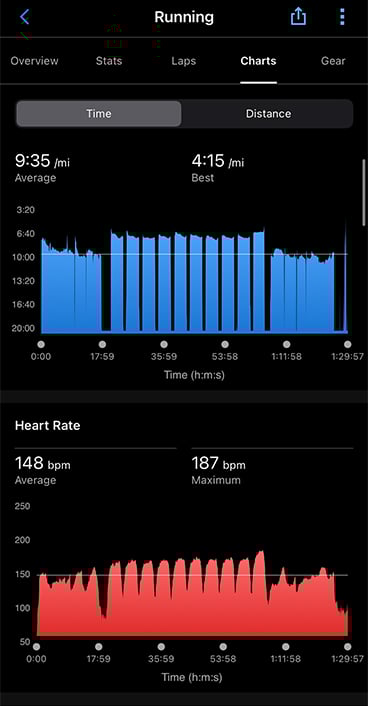
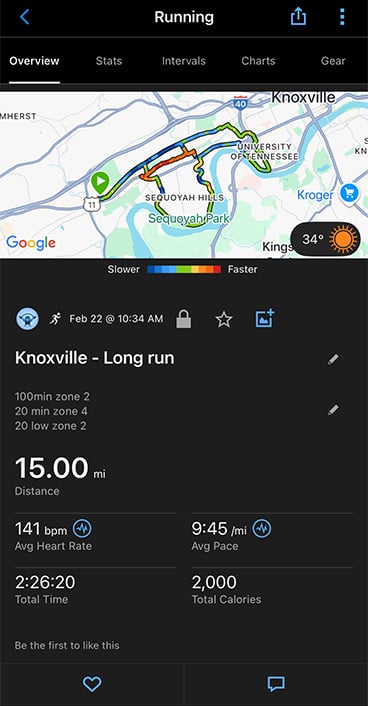
Scott provided two examples of his heart rate during runs, shown above.
How did you prioritize your needs during training?
SS: I really utilized the watch to dictate how I did a lot of things. I basically never took it off other than to charge it. If you truly utilize the technology around you for training, when it comes down to it, you can really go out there and execute a plan.
The same thing in golf, like I don’t sit there and think about my clubhead speed or my path or anything like that. I utilize technology to help train that when I’m practicing, but when it comes time to play,…